


CRUST – Part 1
Family-owned businesses are unique ecosystems where emotions, relationships, and financial interests intersect. Through years of working closely with such businesses, we have identified six core values that consistently shape their long-term success. Together, these values form the framework we call CRUST:
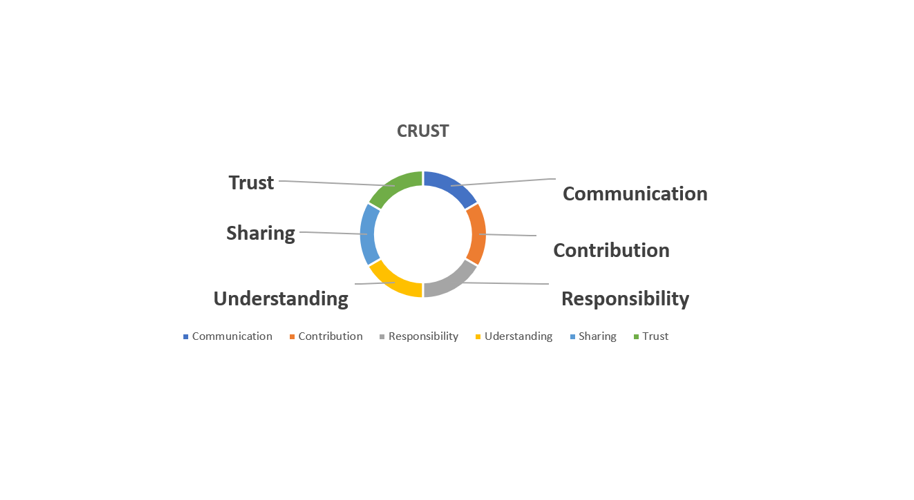
Communication, Contribution, Responsibility, Understanding, Sharing, and Trust.
This series explores each of these pillars, beginning with the most fundamental of all, Communication.
Family Business or Business Family?
Before diving deeper, every family enterprise must ask itself an essential question:Are we a family business, or a business family?
While the distinction may seem subtle, it significantly influences decision-making, governance, and long-term sustainability. Statistics reveal a stark reality, only 6–8% of family businesses successfully transition into the third generation. This makes it critical for families to assess whether they are truly prepared to build a multi-generational legacy.
From our experience, the challenges faced by family businesses broadly fall into two categories:
Tangible challenges: Wealth, assets, ownership structures
Intangible challenges: Behaviour, communication, aspirations, ego
While tangible issues are easier to identify and address, it is the intangible challenges that often determine success or failure.
Why Communication Matters
At its core, effective communication is not just about what you say, it is also about:
How you say it
When you say it
Where you say it
In most cases, the root cause of conflict within family businesses is either miscommunication or lack of communication.
Too often, difficult conversations are postponed. Concerns are set aside with the intention of addressing them “later.” However, delayed communication rarely resolves issues, it only allows them to grow more complex and harder to manage.
The Pressure Cooker Effect
When thoughts and emotions are consistently suppressed, they don’t disappear, they accumulate. This leads to what we call the “Pressure Cooker Effect.” Just like a sealed cooker builds pressure over time, unexpressed feelings eventually reach a breaking point.
When that happens, the result is often:
Emotional outbursts
Poorly timed reactions
Escalated conflicts
Such reactions, especially in inappropriate settings, can damage both relationships and business stability.
When Is Communication Complete?
Communication is not complete when something is said, it is complete when it is understood as intended.
The responsibility lies primarily with the communicator to ensure clarity. Misalignment between the sender and receiver can distort even the simplest messages.
It’s important to remember: You can be right from your perspective without the other person being wrong.
This is similar to the story of the six blind men describing an elephant, each perspective is valid, yet incomplete. Effective communication bridges these gaps.
The Silent Barriers to Expression
In many family businesses, communication is often hindered not by intent, but by hesitation. Individuals hold back due to questions like:
What will others think?
Is this the right time?
Will this create conflict?
Should I address this later?
These internal doubts lead to silence, and silence leads to misunderstanding. Unaddressed concerns rarely fade, they intensify over time.
Creating Structured Communication
One of the most common gaps in family businesses is the absence of formal communication platforms.To address this, families should establish structured forums such as: Family Councils or Family Assemblies.
These platforms provide a safe and defined space to discuss both family and business matters. Equally important is setting. Regular timelines for meetings. Clear agendas and processes. When individuals know where and how to raise concerns, resolution becomes far more effective.
From Conversations to Clarity
When communication breaks down, narratives take over. Discussions turn into:
My version
Your version
The truth somewhere in between.All perspectives may hold some validity, but without open dialogue, alignment becomes impossible.Clear, consistent communication prevents misunderstandings from turning into long-standing conflicts.
Communication is not just a soft skill, it is the foundation of a successful family business legacy.It requires openness, timing, structure, empathy.More importantly, it requires the willingness to engage, even when conversations are uncomfortable.
In the journey of building a multi-generational enterprise, mastering communication is not optional, it is essential